

RSL Sub-Branch
InformationInformation
Want to join the Sub-branch?
Information
Want to join the Sub-branch?
The Ourimbah RSL Sub-Branch was formed in 1920 and today has a membership of about 100 veterans. Download the relevant application form below, or speak with our Membership officers at the club.
Sub-Branch meetings are held 2nd Sunday of every month from 10.30am.
Club Information
President Howard Bell (OAM)
Vice President George Burrows
Secretary Ian Turpin
Treasurer Geoff Talbot
Pensions/Advocate Cathy Every
Welfare Geoff Talbot
Membership Ian & Lynette Turpin
RSL Mission Statement
To serve the interests of its members, veterans, the ex-service community and members of the Australian Defence Force, the RSL executes its roles by effectively implementing the following objectives which are in accord with the League’s Mission Statement:
RSL Mission Statement
To serve the interests of its members, veterans, the ex-service community and members of the Australian Defence Force, the RSL executes its roles by effectively implementing the following objectives which are in accord with the League’s Mission Statement:
Welfare
Advocacy and Representation
Assistance to all veterans and ex-service men and women regardless of their membership in the league
Commemoration and Rememberance
Participation in employment programs for veterans, ex-service members and their dependants
Commitment to democratic principles and practices
Provision of a means for members to enjoy camaraderie and mateship
Provision of effective and efficient management of RSL assets and resources
For the benefit of its members and serving members of the Australian Defence Force
Act as an effective lobby group to the government and its departments
Provision of moral and active support for the Australian Defence Force
Provision of a respected and meaningful voice within the community and the Australian society
Promotion of loyalty and pride which the League has for it’s Nation, it’s people, the Crown and the Flag
Supporting the Australian Defence Force
RSL Standing Policy states that the primary objective of Australia’s Defence and foreign policies should be to promote Australia’s national security and safeguard Australia’s vital interests. To meet such an objective, the RSL believes that Australia should maintain:
Regular armed forces (Navy, Army and Air Force elements) to be of a size able to operate without additional forces in limited roles, and with additional forces in major roles either at home or overseas
Reserve forces (Navy, Army and Air Force elements) able to augment the regular forces, on call out able to undertake combat operations with minimum additional training and able to be mobilised in times short of war
Cadet forces
A national service scheme in the form of military or civilian service to provide a reserve of trained and disciplined manpower
A Defence industry
A National Defence infrastructure
RSL support points of particular significance are:
Defence Policy should be above party policies
The Defence vote should be progressively increased to be not less than 3.5% of the Gross National Product
The special nature of service in the Australian Defence Force should be recognised by the provision of adequate housing and financial conditions of service members and their families
The Navy, Army and Air Force Reserves must be active and essential components of the Australian Defence Force
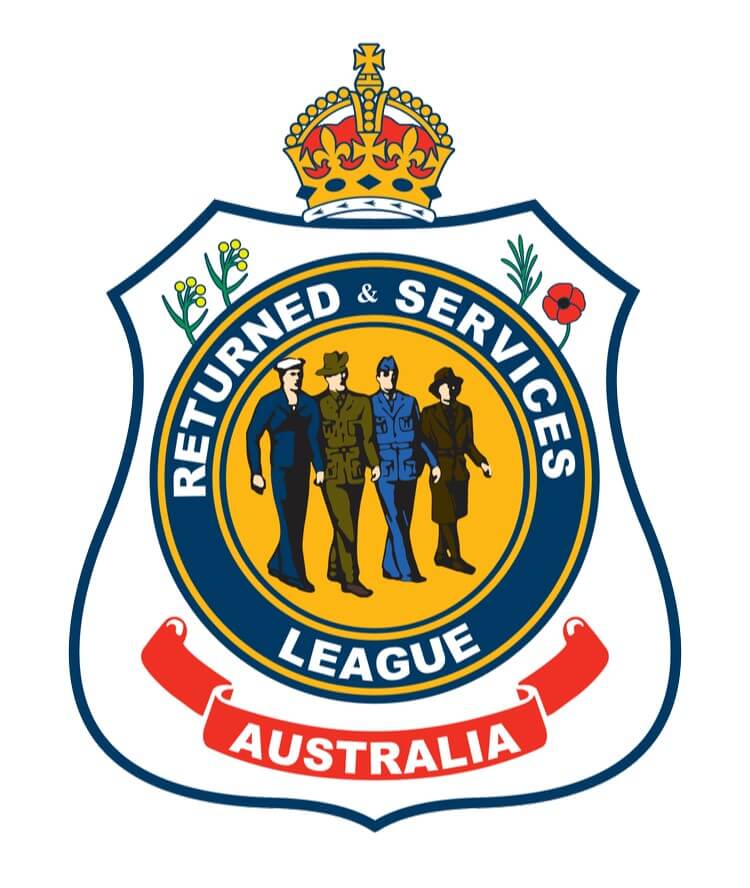
The Badge
The badge is a symbol of a readiness at all times to render service to the Crown and Nation and to former comrades. It is a time honoured emblem, one that has been worn with a deep sense of pride by the most revered in our land and one that glorifies all privileged to wear it. Neither wealth, nor influence, nor social standing can purchase the badge which may be worn in honour only by those who have rendered service in the armed forces of the Crown or its allies. We would ask that you look upon your badge as an inspiration to good citizenship, cherishing it as a symbol of all that is best in our national life and living up to the high ideals on which the organisation is based.
The badge has evolved as the League has evolved:
1915-1919, badges were state based Returned Soldiers Associations. In 1916 a national Returned Soldiers Association badge appeared gradually replacing the state badges
By 1919 the Returned Sailors and Soldiers Imperial League badges evolved, after the reduction in size in 1922 it remained in use until 1941
1941-1966 the Returned Sailors, Soldiers and Airmans Imperial League badge was used until a change of name in 1966 when the Returned Services League badge was introduced, with a change of Crown in 1971, the badge remained in use until 1990
In 1990 the present Returned and Services League badge was introduced
The Women’s Auxiliary badge has remained structually unchanged since its inception in 1922, reflecting only the change of initials of the League
The changes to name and badge since 1916 reflect the nature of the League and its ability to adapt to reflect stabilised changes about it
In 1923 the 8th national Congress of the League adopted the motto “The Prince of Liberty is Eternal Vigilance”. The motto and it’s significance is clearly reflected in League policies on National Defence and support for the Australian Defence Force
Ourimbah History
Formed in 1920, a century of service on the Central Coast.
Ourimbah History
Formed in 1920, a century of service on the Central Coast.
1920
This branch was formed in 1920 after soliders returned from the 1914-1918 war with a cenotaph being erected in 1921.
1947
The Women’s Auxiliary was formed on the 17th March 1947.
1957
The club formed in 1957 using a saw mill office, drill hall, branch meeting room dance hall and produce store. It lasted for 18 years.
1965
In 1965 the premises were extended which included a large auditorium and stage.
1974
In 1974 the premises were again extended moving onto the original bowling green which was moved to its current location. The club was again renovated into its current position.
Today
The Sub Branch has a current membership of about 100 veterans with monthly meeting held on the second Sunday of each month.
Original meetings were held in Ourimbah Public Hall on the service station site opposite the Tall Timbers Hotel. Anzac Day marches commenced from the hall to the Cenotaph, then returning to the hall for a religious service.
So far Our Adopt a Digger program we have raised sufficient monies to dispatch nearly 2000 x 2kg care packages to Australian Defence Personnel serving oversea’s. Members enjoy social outings to sites of interest and regular BBQ’s.
We have Pension and Welfare officers trained with the most up to date methods to assist the veteran community and their loved ones.
How we help
Membership, pensions and welfare support
How we help
Membership, pensions and welfare support
Membership
Any person who has served in the Australian Defence Force or served with or supported or was otherwise engaged with the Australian Defence Force or the Armed Forces of it’s allies, for at least 6 months, or any person provided for in the constitution, may be admitted Service Membership.
Pensions
Advice and preparation of claims under the VEA, MRCA and SCRA.
The duties and responsibilities of the Pensions Officer is to ensure every claiment receives all of the entitlements that they are legally entitled to. His/ her responsibilty is to present the claimants case in the best and most professional manner while ensuring that to the best of their knowledge all matters are factual. Advice and referall to approved Advocacy Services for reviews of above claims.
Claims can be made under various ACT’s of Parliament depending upon the service history of the claimant. These include:
Defence Service Homes ACT 1918
Safety, Rehabilitation and Compensation ACT 1988
Military Rehabilitation and Compensation ACT 2004
Veterans Entitlement ACT 1986
Military Compensation ACT 1994
Military Rehabilitation and Compensation (Consequential and Transitional Provisions) ACT 2004
In addition all of our staff are fully versed in the requirements of the Freedom of Information ACT 1982 and Privacy ACT 1988.
Welfare
Advice and referral to appropriate DVA services, such as DVA Homecare, DVA Homefront Program, Rehabilitation Program, etc.
Advice regarding DVA health entitlements, transport and concessions
Home and hospital visitations
Promotion of and referrals to community care services
Advice and assistance with lifestyle changes such as moving into care facilities
Liaise with the local service providers on veterans behalves
Personal councelling
Bereavement support and advice
Represent Sub Branch at members funeral services
Facilitate RSL tributes upon families request
Get in touch
Speak with our Pensions or Welfare officers
Get in touch
Speak with our Pensions or Welfare officers